
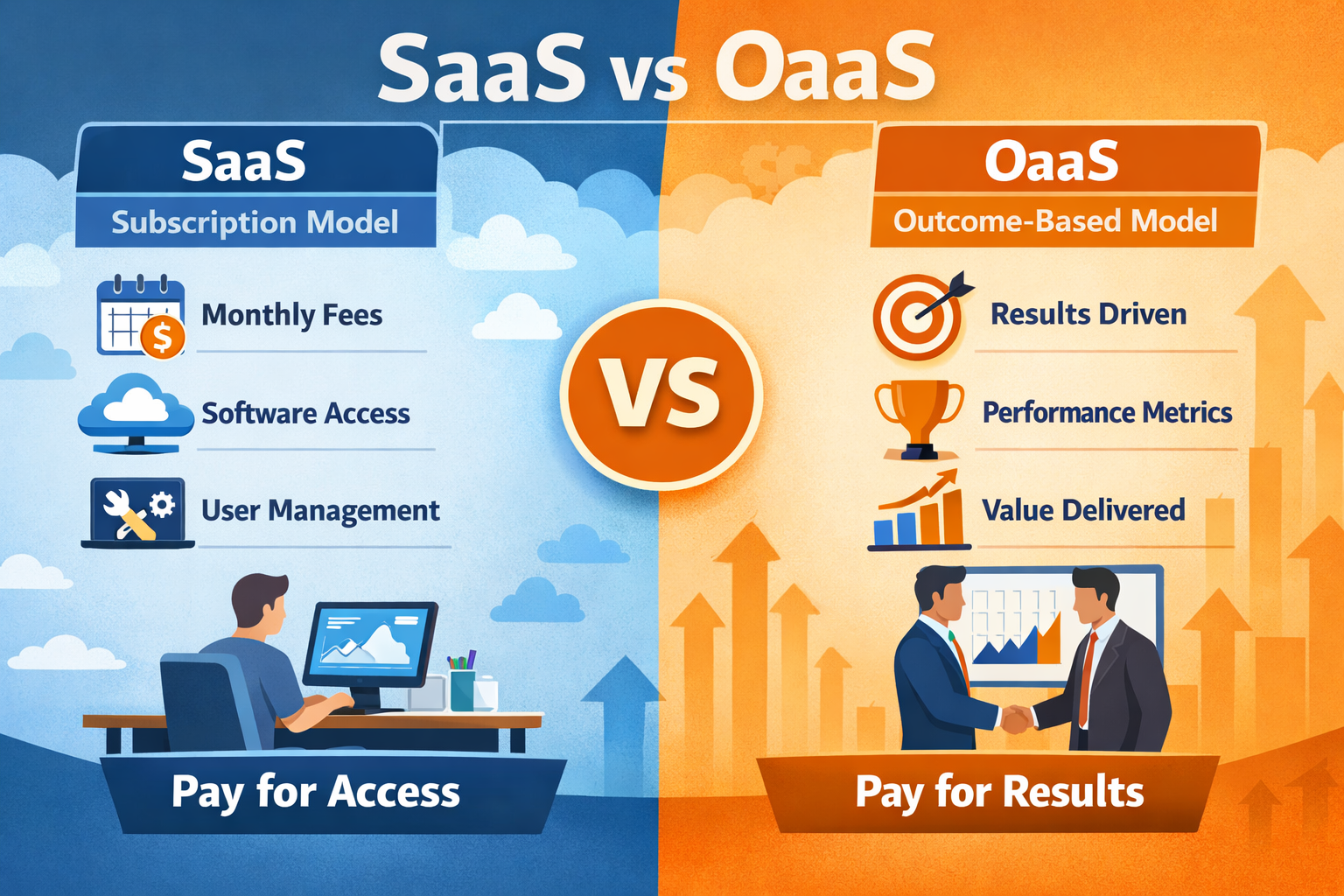
The technology business is in the midst of a colossal shift- not only the way software is developed, but also the way it is packaged and sold. The Software as a Service (SaaS) had reigned over the market with predictable subscription models in the course of more than a decade. However, currently, a new paradigm is being created: Outcome as a Service (OaaS).
This is changing the value, risk and customer expectations. Businesses are no longer paying to access tools but they are paying to get results.
What is SaaS and Why It Dominates.
The emergence of Subscription-Based Models.
SaaS transformed the software market to a new level where businesses were no longer required to spend a lot of money on purchasing a one-time license but to be able to pay a subscription fee to access it. This enabled both small and big companies to use advanced tools without making significant initial investments. Cloud infrastructure also enabled people to use software anywhere and enhance teamwork and productivity. Consequently, SaaS turned into the standard model of contemporary business.
SaaS Pricing drawbacks.
Although it has become a popular approach, SaaS pricing is not without limitations. Companies usually incur certain subscription fees irrespective of the value they actually obtain. This may create inefficiencies particularly when there is underutilization of the tools. Also, it makes it hard to measure the return on investment since pricing is not directly correlated with results, which can be frustrating to cost-conscious organizations.
What is OaaS (Outcome as a Service)?
Meaning and Basic Idea.
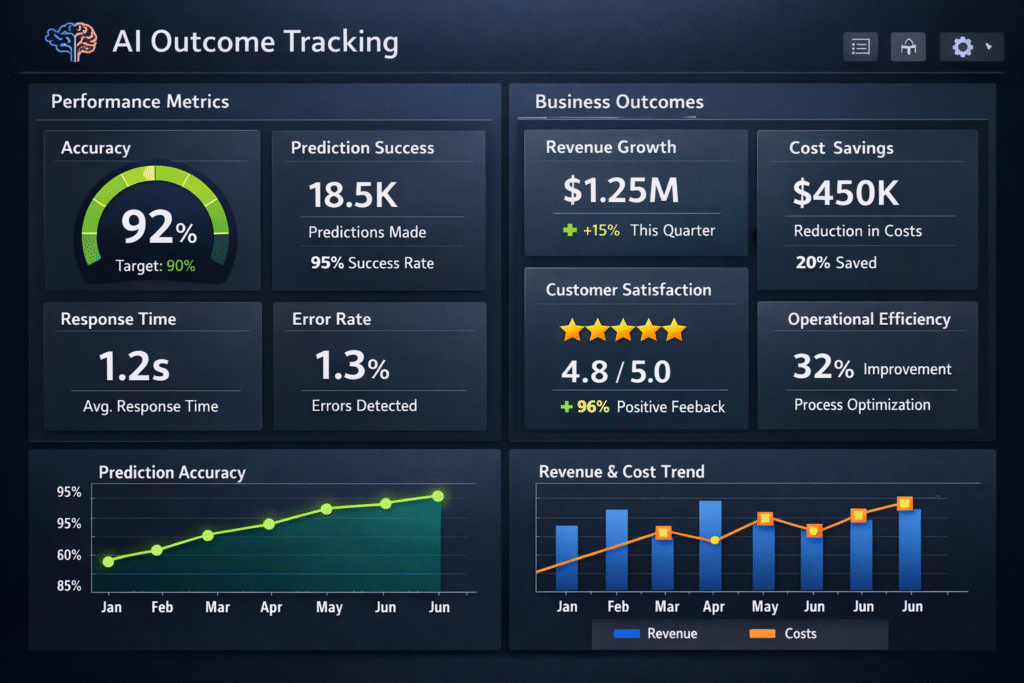
Outcome as a Service (OaaS) is a performance-based pricing service, in which customers are charged based on performance, rather than access. Instead of paying to use software capabilities, companies invest in results like more revenue, greater conversions, or greater efficiency. This model places an emphasis on the tools to real business impact.
How OaaS Works
OaaS is based on the latest technologies such as AI, automation, and real-time analytics that help to monitor and provide quantifiable outcomes. Vendors become part and parcel of client systems to keep track of performance and optimise results at all times. Pricing is usually calculated through the number of leads generated, number of tasks accomplished or cost saved and only real value delivered is paid by customers.
The Reason behind the Change of SaaS to OaaS.
Measurable ROI Demand.
The nature of businesses of today is more data-driven, than outcome-driven than ever before. Investors would desire to see the way their money is spent and how it helps the growth. OaaS helps to meet this requirement by eliminating the need to externally match cost to performance and consequently making it easier to justify spending and quantify success.
AI and Enabling automation.
The high rate of development of artificial intelligence and automation technologies has enabled OaaS to be implemented on a large scale. These tools are able to process bulk data, forecast and streamline processes in real time. Such accuracy enables vendors to be sure of providing performance based pricing models.
Competitive Differentiation
As the SaaS market is becoming saturated, companies are seeking new ways of differentiating themselves. The use of outcome-based pricing can create confidence and trust with customers and minimise the perceived risk of adoption. It also classifies the vendors as people to whom success, compared to service providers.
OaaS important advantages.
For Customers
OaaS can save the customers a lot of financial risk as they pay only the amount of money corresponding to measurable outcomes. It also offers more transparency to performance and assists businesses to make decisions. OaaS leads to improved partnerships and improved results because it creates incentives to the vendors in line with customer objectives.
For Vendors
To the vendors, OaaS opens up possibilities of developing long-term relationships and customer retention. As performance is linked to revenue, businesses have an incentive to continuously streamline their services. It can contribute to increased customer satisfaction and the possibility of acquiring premium prices because of the proven outcomes.
industries that are on the forefront of the OaaS Movement.
Marketing and Advertising.
Outcome-based pricing has been one of the first to be applied in the marketing industry. Companies tend to pay per quantifiable outcome like a click, lead or conversion. This practice will make sure that the marketing budgets are performance-related.
Recruitment and HR.
With regard to recruitment, companies are paying more to get successful recruits, instead of paying to access recruitment tools. This integrates the goals of recruiters and employers which guarantee a higher outcome and more effective hiring procedures.
Cloud services and IT.
IT services providers are also starting to provide prices depending on system performance, uptime or efficiency improvements. This puts more emphasis on the access to infrastructure and providing reliable and optimized results.
Customer Support and CX.
Customer experience platforms are embracing OaaS by billing on the basis of such metrics as the resolution rates or the score of customer satisfaction. This guarantees companies invest in a higher quality of services and not access to tools of assistance.
Conclusion.
The move towards OaaS is a paradigm of changes in the way in which technology is appreciated and monetized. Whereas SaaS helped in making software more accessible, OaaS has made it more responsible by directly correlating costs with results.
The future of the technology industry will be determined by outcome-based models as companies will be requiring quantifiable achievements and more efficiency. Early adopting companies will have a substantial competitive advantage in this changing environment.
FAQs.
1. What is the main difference between SaaS and OaaS?
SaaS and OaaS are different in that the former is paid to access software whereas the latter is paid depending on the results or outcomes attained by using software.
2. Is it possible to have both SaaS and OaaS?
Yes, lots of businesses are going hybrid with a subscription and performance-based component to provide flexibility and value.
3. What is the reason why OaaS is becoming popular?
OaaS is becoming more popular as companies are seeking definite ROI and less risk to their finances, which outcome-based pricing offers successfully.
4. Which industries are embracing IaaS the most?
Marketing, recruitment, IT services, and customer experience are some of the other industries that are adopting the use of outcome-based pricing models.
5. Can all businesses use OaaS?
Not always. OaaS is most effective in a situation whereby results are easily determined and quantifiable.