
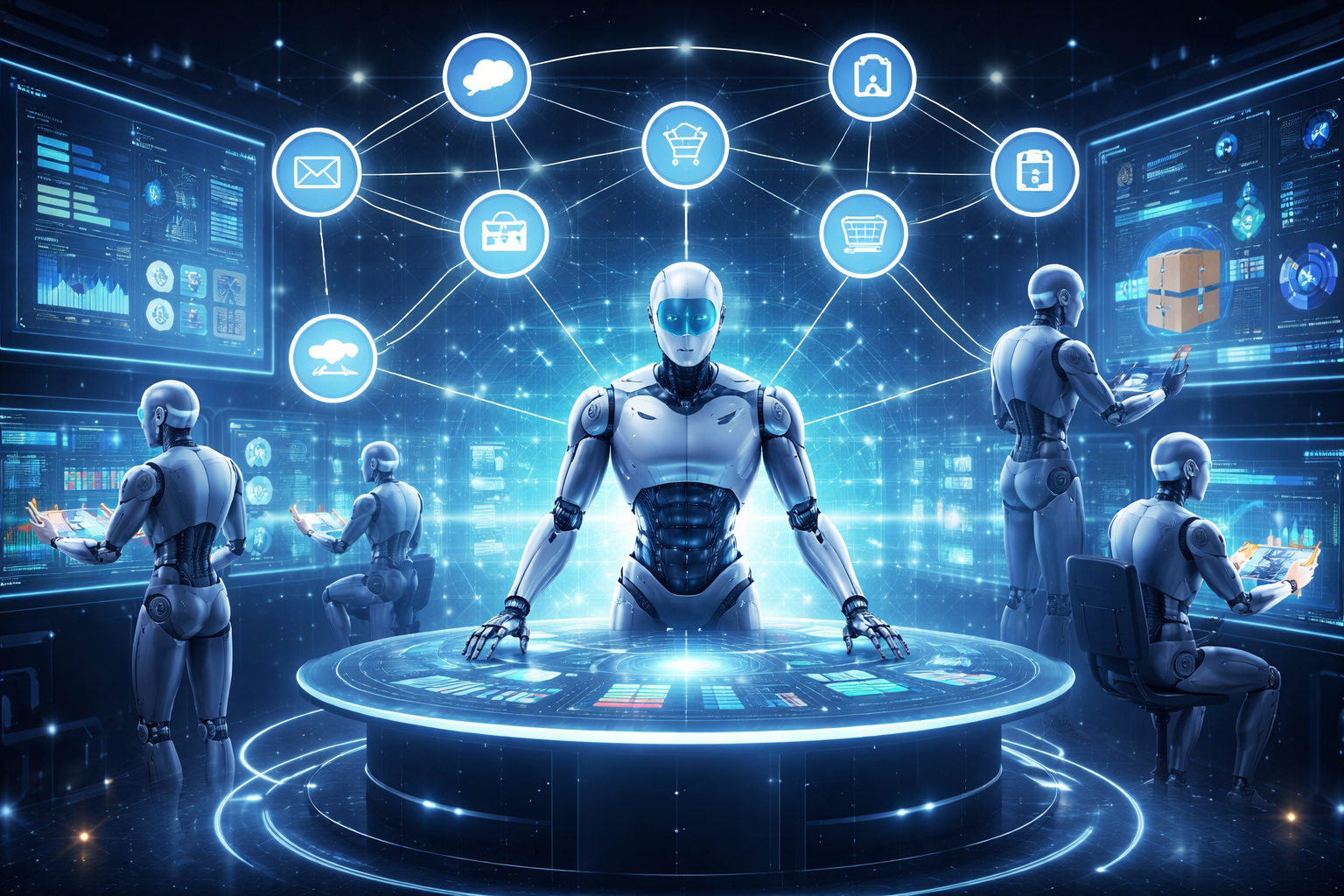
AI is not merely a support system anymore, it is increasingly the main driver of contemporary operations. The move towards AI copilots to entirely autonomous agentic AI autopilots is redefining the way businesses are designed workflows, implement strategies, and scale productivity. This is not a mere technological shift but a structural shift that will affect the decision-making process, the role of the workforce and the organizational models.
What is the Shift? Copilots vs Autopilots.
What Do AI Copilots Mean?
AI copilots are smart assistants, which enable their users to work more effectively. They give us suggestions, eliminate duplicating procedures and make us more productive. Nevertheless, they are much dependent on human guidance and are not able to handle complicated work processes on their own. They are supportive in nature and hence valuable although of limited scope compared to the autonomous systems.
What are Agentic AI Autopilots?
The following evolution of AI is agentic AI autopilots. These systems do not need a human operator, as they make decisions, perform multi-step processes and optimize processes in real-time. They do not wait to be instructed but analyze the goals, develop plans and then take actions. This independence helps organizations to be more efficient and scalable.
The main differences between Copilots and Autopilots.
- Copilots help humans, autopilots substitute the workflow implementation by humans.
- Copilots need to be prompted, the autopilots take a step on their own.
- Micro-tasks are worked on by copilots and macro processes by autopilots.
- Copilots are user-controlled, autopilots are dynamically controlled.
- Copilots enhance faster speeds, autopilots revolutionize the whole operation.
The Emerging Agentic AI in the Workflow.
Automation Beyond Tasks
The agentic AI goes beyond mere automation and is able to handle workflows. It ties together several processes- data collecting, data analysis, implementing- into a smooth process. This gets rid of the fragmentation and there is uniformity in the results of the operations.
Multi-Agent Collaboration
The contemporary workflows implement multiple AI agents, as opposed to a single system. All the agents work together in a particular function, forming a networked ecosystem that emulates human teams but works more efficiently and quickly.
Real-Time Decision Making
Such systems are constantly processing incoming data and coming up with real-time decisions. This is possible, and it enables the business to react to changes on the spot, minimizing the delays and enhancing accuracy in dynamic business settings.
Integration Across Systems
The concept of agentic AI can be added to other enterprise systems like a CRM platform, analytics dashboard, and working system. This forms one digital infrastructure in which there is free flow of data and processes are interrelated.
Ongoing Learning and optimization.
In contrast to conventional automation, agentic AI gets improved with time. It acquires experience based on the results of the past, finds a lack of efficiency and advances its performance. This is a long-term value and flexibility that is guaranteed by this ongoing optimization.
Industries that are Being Changed by Agentic AI.
Content and Marketing Automation.
AI autopilots are able to plan campaigns, create content, post and analyze performance, without human intervention. This allows brands to run at scale and be consistent and fast.
Software Development
The whole development lifecycle is being simplified with agentic AI. These systems decrease the amount of human resources and speed up delivery schedules, whether they are writing and testing code or deploying and monitoring it.
Customer Support
Self-sufficient agents respond to customer requests, find solutions and escalate complicated cases as necessary. This enhances productivity as well as customer satisfaction.
The advantages of Agentic AI Autopilots.
- Removes redundancy and minimizes human efforts.
- Facilitates smooth operations and prevents downtime.
- Enhances precision and decreases mistakes.
- Improves scalability of business processes.
- Further accelerates the performance and productivity.
Risks and challenges of autonomous AI Systems.
- Human control can be very limited and thus can result in unintentional decisions.
- Accountability and transparency issues of ethics.
- Reliance on good and well-organized data.
- Greater exposure to cybersecurity risks.
- Disruption of the workforce that needs reskilling and adapting.
Future of Work Human + Agent Collaboration.
Human-AI Synergy
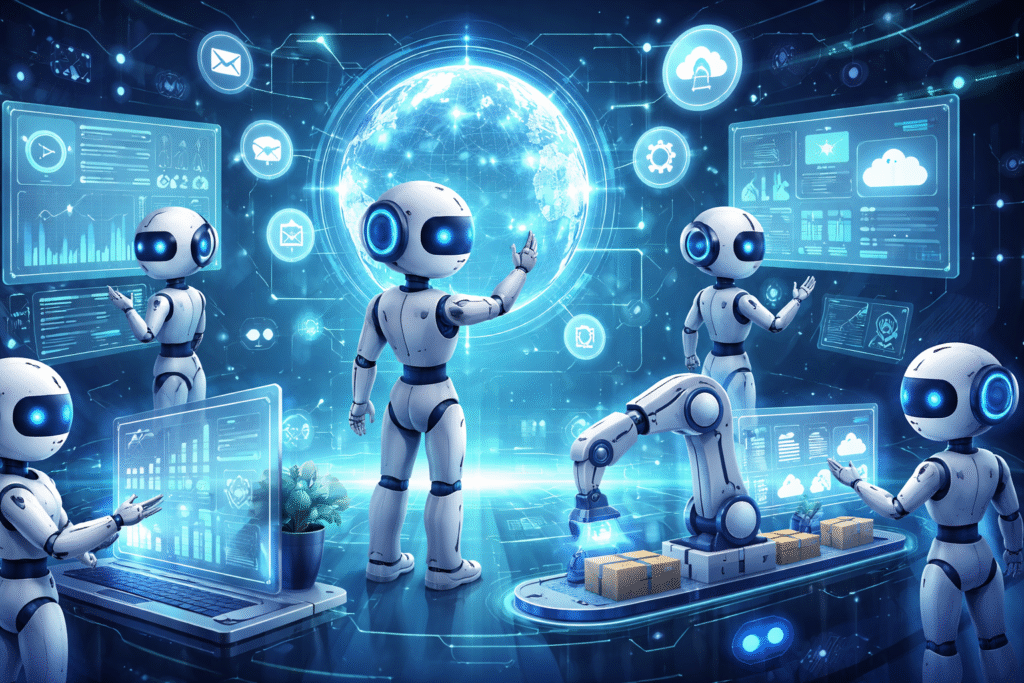
Living in harmony with humans, agentic AI does not substitute human abilities. When it comes to execution and optimization, AI takes care of the task, whereas humans are concerned with creativity, strategy and critical thinking. This synergy makes a more balanced and productive working environment.
Emerging Trends
New models of the workplace are emerging as a result of the emergence of agentic AI. Businesses are embracing AI-based operations, whereby virtual agents become the members of the team. This change is also establishing positions that deal with the management, training and oversight of AI systems.
Business Implementation Strategies.
Start with Hybrid Models
Combinations of copilots and autopilots should be initiated by organizations. This enables a gradual adoption as well as control over critical processes.
Infrastructure Data – Build Strong.
Good data is a necessity to agentic AI. Companies need to invest in the data management system to provide accuracy and dependability.
Concentrate on Governance and Ethics.
There is a need to have clear guidelines and monitoring systems that can help in the use of AI responsibly. This involves setting accountability and transparency.
Long-term Organization Effects.
Agents AI is not an instrument, but a revolution in the way organizations work. It allows companies to shift to proactive and predictive frameworks other than reactive frameworks. With time, organizations embracing such technologies will be more agile, data-driven and competitive in the international market.
Conclusion
The replacement of copilots by autopilots is one of the milestones in the history of artificial intelligence development. The workflows are being redefined, productivity is being improved, and the automation is becoming possible at new degrees with agentic AI. Although, this has challenges, the benefits that may accrue are far greater compared to the risks that may arise when done in a responsible manner. Companies that undertake this change will not just enhance efficiency but they will also be at the forefront in the age of innovation in the digital era.
FAQs
1. What is Agentic AI?
The term agentic AI is used to refer to autonomous systems, i.e. systems that make decisions and perform workflows without requiring human intervention.
2. What is its difference with traditional automation?
Repetitive work is dealt with by traditional automation and full workflows by agentic AI, which is dynamically adaptable.
3. Can Agentic AI be applicable to small businesses?
Yes, even small businesses can enjoy the advantages of automation and increased efficiency with scalable solutions.
4. What do you think are the skills required in an AI-driven workplace?
Such skills as critical thinking, data analysis, and managing the AI will gain more significance.
5. What does AI have in store in workflows?
AI will keep developing to complete autonomy, and establish newer and smarter business ecosystems.