
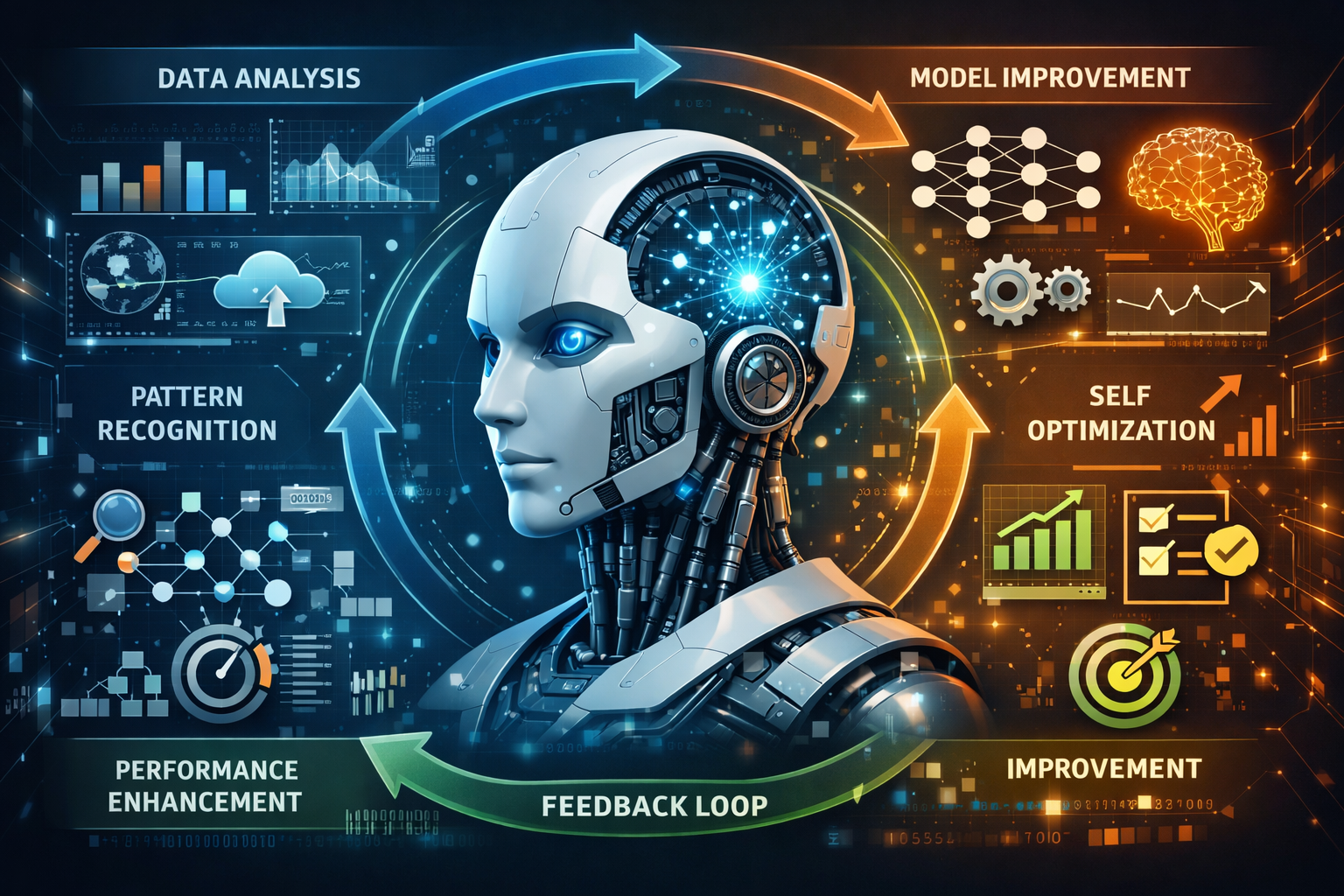
By allowing machines to increase their performance without necessarily having human assistance, self-learning AI systems are redefining automation in 2026. The systems do not need manual retraining as opposed to the traditional AI models which do not continually evolve through the use of real-time data and feedback. This changes are rendering digital systems smarter, more responsive and able to perform complex tasks without human intervention. Self-learned AI is a primary source of innovation and efficiency as it becomes an indispensable part of the fast and smart solutions required by industries.
What Are Self-Learning Artificial Intelligence?
Advanced artificial intelligence systems that are created to automatically enhance their performance with time are called self-learning AI systems. Such systems observe the trends, acquire experiences and develop their behaviour without necessarily being explicitly programmed to do so. They are able to adjust to new situations and make more successful decisions every time they interact with new situations using techniques such as machine learning and reinforcement learning. This capacity to keep on changing, makes them very useful in rapidly changing environments.
The mechanism of Self-Learning AI.
Learning Process
- The data is constantly being gathered as user interactions and system inputs.
- AI determines the trends and patterns in the data.
- Feedback loops assist to identify the mistakes and enhance decision-making.
- The system is self updating to perform optimally.
The learning process forms a cycle of continuous improvement as the system gets smarter with each interaction. With time, the AI becomes more adaptable and efficient in refining its responses and decisions and thus does not need manual updates.
Technologies Behind It
- Machine Learning Algorithms
- Neural Networks
- Reinforcement Learning Models
- Big Data Processing Systems
Self-learning AI systems are based on these technologies. They enable machines to handle extensive amounts of data, identify patterns and dynamically change. Consequently, the system will be smarter and can deal with complex real-world problems with little human intervention.
Real-Time Adaptation
The self-learning AI systems constantly adapt to new incoming data to the behavior they have. This implies that they would be able to react immediately to the change in user behavior, environmental conditions or system inputs. With time, this flexibility results in better predictions and smarter decisions, thus AI systems are very effective in dynamic settings.
Continuous Optimization
Self-learning AI can also optimize itself over the course of time, which is another important feature of self-learning AI. The system also measures its previous performance and finds the areas where it is not efficient and also enhances its processes as a matter of routine. This will provide a system that is more effective and reliable in the long-run since performance continues to improve without the need to involve manual intervention.
Self-Learning AI Systems in use.
Self-educating AI is revolutionizing various industries through offering intelligent and more flexible solutions. In intelligent assistants, AI enhances the reaction by learning with time and user behavior and preferences. In self-driving cars, AI constantly improves their navigation and safety choices according to the real-life driving circumstances.
Self-learning AI can be applied in e-commerce where platforms provide extremely personalized suggestions of products to customers, increasing customer experience and driving sales. When it comes to cybersecurity, AI systems identify and react to threats by analyzing patterns and emerging attack patterns. Another significant field in which self-learning AI enhances the accuracy of diagnoses is healthcare, when the information about the patient and medical trends is analyzed.
Benefits of Self-Learning AI
The benefits of self-learning AI systems are immense and hence they are needed in contemporary automation. They make things more efficient, as they do not require a manual approach and allow completing the tasks more quickly. With time, these systems enhance accuracy through learning previous errors and streamlining their operations.
They also have the advantage of scaling, where the organizations can manage high levels of data and operations without having to scale up. Immediate response to changing conditions by real-time adaptation means that systems do not need to run continuously supervised by humans and updated, and cost-cutting is realized by minimizing the need to do so.
Challenges and Risks
Although self-learning AI has numerous benefits, there are various challenges that need to be tackled. A significant issue is the dependency of data as the quality of the results is closely related to the quality of input data. Inaccurate or unjust decisions can be made in case of poor or biased data.
The problem of lack of transparency is another one since complicated AI models may be hard to understand. Security risks are also more pronounced as systems will be more autonomous and will be able to make independent decisions. Ethics are an issue that arises when using AI in the absence of human control, particularly in such a sensitive field as health or the economy. These issues need to be tackled to provide responsible and safe use of AI.
Self-Learning AI: Future.
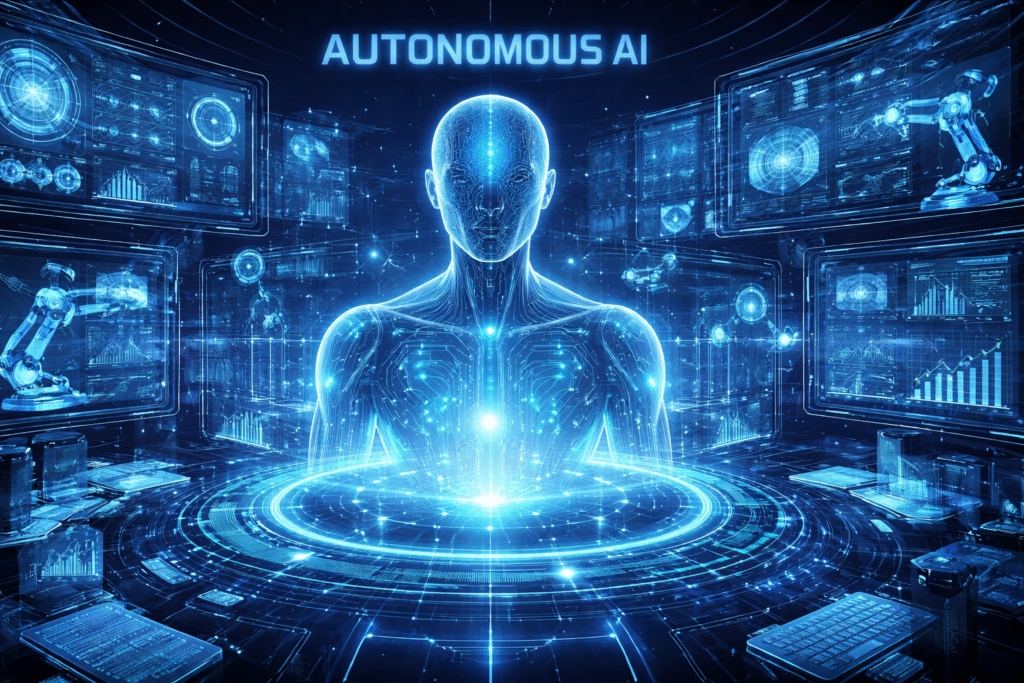
Self-learning AI is headed towards the future of using highly autonomous systems that will make complex decisions in real time. These systems will significantly contribute to the transformation of financiers, health care, logistics and manufacturing industries. Rather than replacing humans, AI will be used in collaboration with them, improving their productivity and making decisions.
The new AI technologies will result in a rapid development cycle and smarter systems due to continuous innovation. The next wave of digital transformation will be self-learning models which are increasingly becoming more advanced, and automation will be more intelligent and adaptive than ever.
Conclusion.
Self-learning AI systems are one of the biggest changes in the operation of automation, as they shift to dynamic and changing intelligence, instead of remaining in static programming. These systems are not only enhancing efficiency, but also bringing new possibilities in the industries. Although issues like data quality, security and ethics are present, the risks are relatively less when addressed appropriately as compared to the potential benefits. Self-learning AI will be a fundamental component of the digital ecosystem of the future, as technology keeps advancing.
FAQs.
1. What is a self learning AI system?
A self-learning artificial intelligence (AI) system is an AI model that automatically improves its performance based on data, without needing manual updates.
2. What is its contrast to traditional AI?
The old school of AI requires human intervention to update its information, whereas the new school of AI automatically adjusts and transforms itself.
3. What are the typical applications of self-learning AI?
It finds wide applications in health care, e-commerce, e-security, self-driving cars, and intelligent assistants.
4. What are the risks of self-learning AI?
Examples of risks are biased data, lack of transparency, vulnerability, and ethical issues.
5. Will self-learning AI take away the work of people?
It can rather boost human abilities and output than totally eliminate occupations.