
March 2026 Global Tech and Innovation Desk.
By the year 2026, the story of global venture capital (VC) is radically changing, and the way startups receive funding, scale, and position themselves to grow in the long term is undergoing substantial changes. Following a market-adjustment and investor-paranoia period, the pace of venture capital is returning to normal and venturing into what is being dubbed by analysts as the value creation era by venture capital—the era of sustainable growth, strategic investment, and breakthrough technology.
High-impact innovation areas, including artificial intelligence, climate technology, fintech infrastructure, and deep-tech research, are among those that are being focused on by venture capitalists across industries. Such trends are reshaping the startup economy around the world and affecting the process by which founders will construct companies in the competitive innovation economy of 2026.
What Venture Capital will be in 2026.
The venture capital industry has moved through rapid speculative investment into a more disciplined type of investing that has focused on profitability and long-term value creation. The capital is currently being concentrated by investors in more quality startups, but fewer of them, which leads to a barbell-shaped funding environment full of active startups at the early stage of innovation and massive investments in established market leaders.
Although the total number of deals has decreased marginally, the amounts of funds being raised grow, particularly in areas with a proven scaling technology and high product-market fit. This emerging field of investment is accelerating founders to illustrate more lucid business paradigms and long-lasting income streams sooner in their establishment progress.
Venture capital investment is conquered by artificial intelligence.
AI as the Engine of Global Startup Funding.
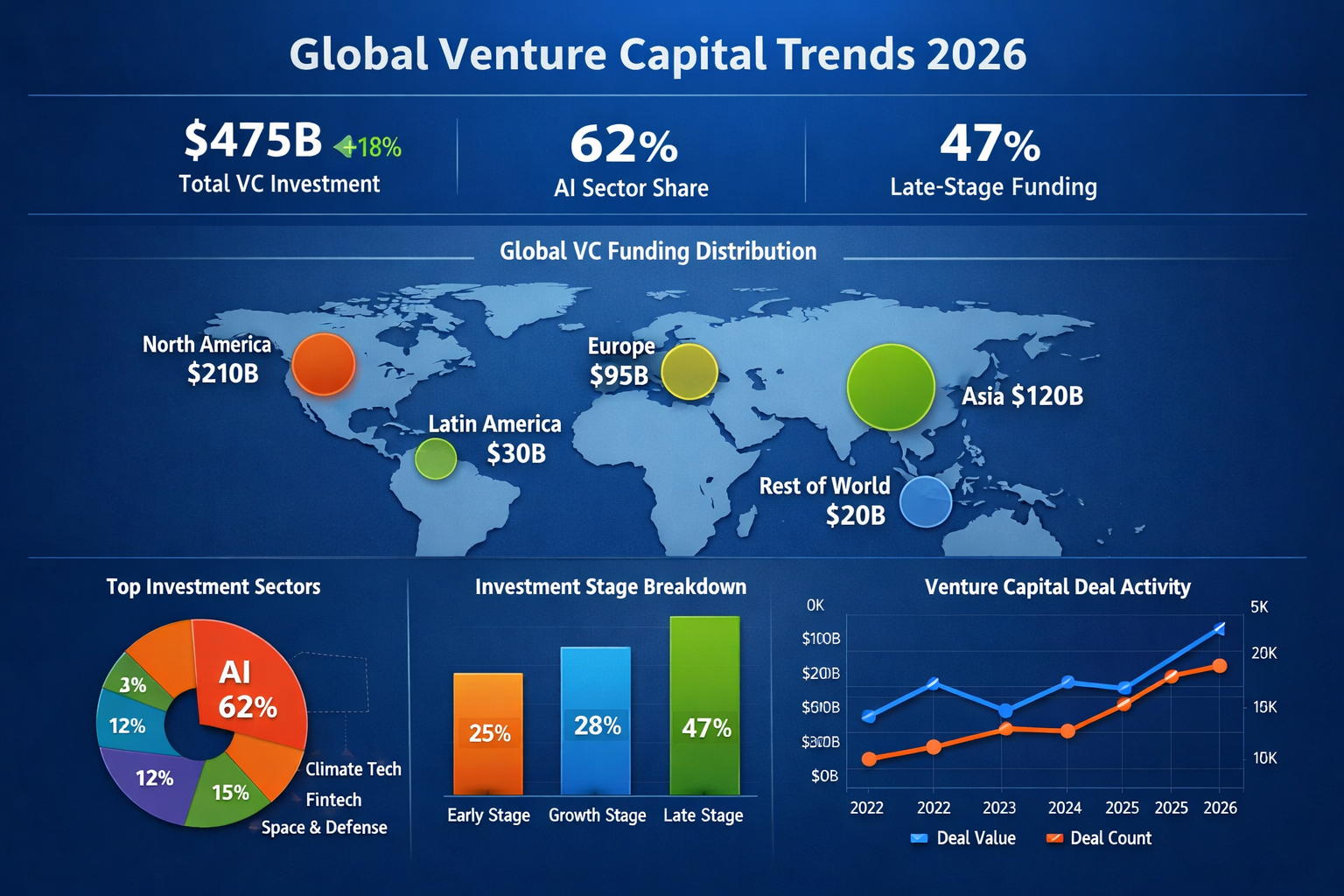
Venture capital funds all over the world are still dominated by artificial intelligence. The industry became the biggest investment magnet for startups, with AI startups taking over 60 percent of venture deal value in 2025.
Recent data available globally shows that in 2025, the total number of venture capital investments in AI companies surpassed 258 billion, which is more than half of all VC investments in the world.
The fact that AI funding has increased shows that the investors are confident that AI technologies, such as generative AI, machine learning infrastructure, and autonomous systems, will characterize the next-generation digital platforms.
Mega Funding Round in AI Startups.
The amount of venture capital investment in AI innovation is reflected in recent funding rounds. As one instance, a start-up led by a former head of a large technology firm recently raised more than 1 billion dollars in seed funding, showing a level of investor confidence never seen before in next-generation AI technologies.
These mega rounds are hastening the creation of advanced AI systems that are able to reason, automate, and solve problems in the real world in all industries.
New Investment Segments outside AI.

In spite of AI, the venture capitalists are diversifying their portfolios in a number of high-growth areas.
Climate and Energy Technology.
The climate tech startups are also in great momentum due to the focus on sustainability by governments and corporations. Innovations in renewable energy, reducing carbon, grid infrastructure, and decarbonizing industries are being funded by investors.
Fintech Innovation
The renewed interest of investment is also being experienced in fintech startups. Financial services are digitally transformed, with billions of dollars of venture funding going into payments platforms, embedded finance solutions, and digital banking infrastructure.
Space Technology, Defense, and Cybersecurity.
Digitalization of the world and geopolitics have increased investment in defense technology, cybersecurity applications, and space infrastructure enterprises. These industries are becoming regarded as important units of national security and economic stability.
Mega-round and late investments.
The re-emergence of mega-round financing in the 2026 venture capital market is one of the characterizing trends of the upcoming market.
This year (2025) alone there were dozens of mega rounds that had been completed, indicating that investors had faith in startups that already showed good traction.
Late-stage venture capital has become nearly half of the total amount of capital raised, and it is emphasizing the increase in importance of scaling established startups instead of merely financing experiments at the beginning.
In the case of startups, it implies that the way to significant funding is becoming more and more reliant on the ability to prove the business model, customer growth, and efficiency in operations.
Growth in Institutional and Global Investor Role.
The other key change in 2026 is the increase in the participation of institutional investors in venture capital markets, such as sovereign wealth funds, insurance firms, and pension funds.
These institutions are starting to devote bigger portions of their portfolios to startup investments as they get mesmerized by the long-term growth potential of technology innovation.
In the areas of autonomous mobility, AI infrastructure, and robotics, governments, technology companies, and venture capital firms are also speeding up the development of startups through global investment relationships.
Secondary Markets and Liquidity: New Avenues.
The conventional methods of exit for startups, like initial public offerings (IPOs), are selective, and hence there has been the rise of the secondary markets through which investors can purchase and sell shares of privately held companies.
By 2025, the secondary transactions surpassed $60 billion, which is used to liquidate investors in the early stage, founders, and employees when companies are held longer privately.
The trend has seen startups scale without the rush to the public markets to allow well-built business foundations prior to IPOs.
Startups and the 2026 VC Environment Challenges.
Startups continue to experience a number of problems despite renewed optimism:
- Heightened questioning and discriminatory financing.
- The increase in profitability and sustainable growth expectations.
- Rapid rivalry in both AI and deep-tech.
- Poor global market IPO prospects.
Nevertheless, the venture capital invested in startups continues to be high in the cases where they are able to prove innovative capabilities, scale, and high market demand.
The Future Prospect of Global Startup Ecosystems.
In the future, venture capital will further contribute to the technological breakthrough and transformation of the global economy on a larger scale.
Some of the possible areas that are likely to get high funding within the ten-year period are:
- Innovations in artificial intelligence and self-dealing.
- Environmental technology and green infrastructure.
- Health innovation and biotechnology.
- Supercomputer hardware and quantum computing.
- Satellite networks and space technology.
With the changing nature of venture capital, the dynamic between the investor and the founders will be narrowed to the creation of resilient firms that can produce sustained effects.
Conclusion
By 2026, the venture capital environment is transforming the way start-ups design, develop, and compete in the contemporary economy. The startup ecosystem is at a more mature and strategic stage as investors are looking at sustainable growth, strong business fundamentals, and breakthrough technologies. Although artificial intelligence remains at the forefront of the world, other categories, like climate technology, fintech, cybersecurity, and deep tech, are quickly gaining investor interest.
Simultaneously, new possibilities are emerging with mega-funding rounds, institutional investor involvement, and the growing secondary markets, providing startups with an opportunity to grow large without facing the immediate necessity to go public. This dynamic investment climate makes founders develop strong companies that can give long-term value but not short-term growth.
Frequently Asked Questions (FAQs).
1. What is venture capital?
Venture capital is a form of private capital investment in which the investor makes an equity investment in a startup company at an early stage or during high growth.
2. Why then is AI drawing the highest levels of venture capital?
AI technologies can revolutionize various industries: healthcare, finance, manufacturing, and logistics, and this is why they are of great interest to investors.
3. What do you mean by mega-round investments?
Mega-rounds are venture capital financing that a company receives when it has a proven business model and the potential to grow very fast, such as in excess of 100 million dollars.
4. What are startups doing to raise funds through non-IPOs?
Secondary markets, private equity partnering, and late-stage venture financing are also becoming popular ways by which startups are raising capital without going public for so long.
5. What will be the leading venture sources in the future?
In the coming ten years, venture funds are likely to be dominated by artificial intelligence, climate technology, fintech, cybersecurity, and deep-tech innovations.