
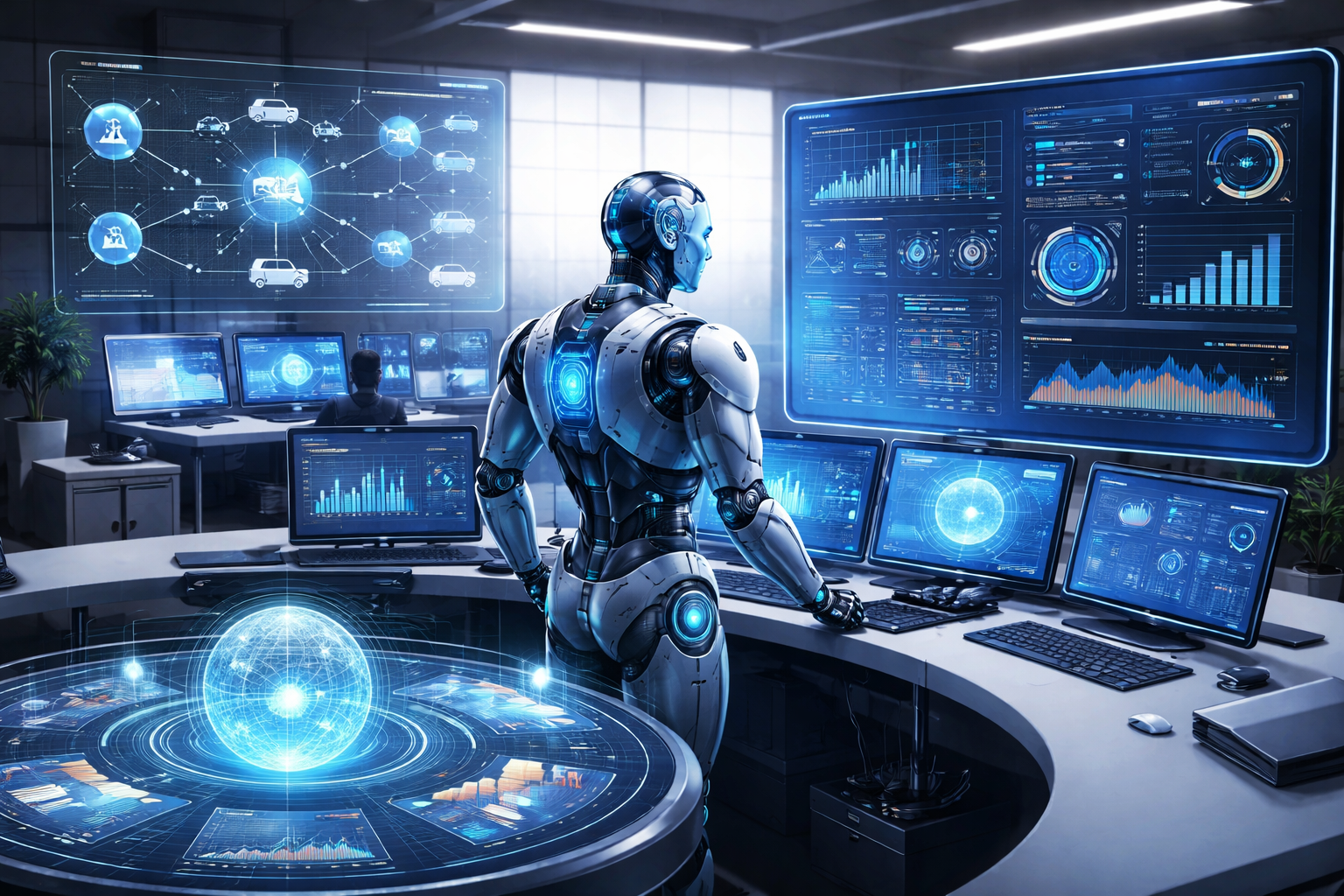
The autonomous AI agents are quickly restructuring the landscape of contemporary business processes, bringing a new era of intelligent automation that is much more profound than conventional software systems. These digital agents can be considered advanced and can execute their tasks independently, make data-driven decisions, and learn and improve their performance through learning algorithms. The rise in pressure on organizations to become more efficient, less expensive, and scalable is driving the concept of autonomous AI agents to become a very important solution in any industry.
Business Automation Evolution.
The automation of businesses has taken a new turn in the last ten years. The previous systems were closely based on rule-based programming, which demanded regular updates and the supervision of the program by humans. Conversely, autonomous AI agents employ machine learning and natural language processing as well as predictive analytics to operate with little supervision. They are able to adjust to new surroundings and work with unstructured information as well as real-time decision-making.
This change is not only a technological change, but it is also a strategic change. Firms are not turning to automation as an auxiliary means of operation, but they are incorporating AI as part of their functioning. The deployment of autonomous agents is currently an attempt to handle the end-to-end processes so that organizations can reach even greater levels of agility and innovation.
Basic Applications in Industries.
1. Smart Customer Interaction.
Autonomous AIs are transforming the way customers are served by delivering instant and personalized services. Such systems are able to process inquiries and solutions to problems and even anticipate the needs of the customers due to their previous behaviors. They work 24/7, and thus they shorten the response time and increase customer satisfaction.
2. Real-Time Data Analysis
The modern data-driven world is characterized by big volumes of information produced by businesses per second. This data is analyzed by autonomous agents in real time; trends are discovered, and actionable insights are presented. This enables the companies to make quicker and more precise choices as well as respond to a change in the market promptly.
3. Automation of Processes and Workflow.
Since the recruitment of workers to accounting and financial services, autonomous AI agents simplify complex workflows. They are able to synchronize the actions of several systems, activate actions due to the set goals, and provide a smooth flow of work with no need for human interference.
4. Supply Chain Optimization
The use of AI agents has increased efficiency in supply chain management. Such systems are able to predict demand, streamline inventories, and manage real-time logistics. They also contribute to the reduction of risks because they recognize possible disruptions and propose other solutions.
5. Sales and Marketing Intelligence.
The way business is done is changing through AI agents and their impact on marketing and sales. They also use customer data to develop personal campaigns, optimize advertising campaigns, and enhance lead generation. They are also useful in sales when it comes to following up on customers and offering information, which would enable the effective closing of sales.
Major Organizational Advantages.
Improved Efficiency of Operations.
Independent AI agents do not get tired, and they are constantly active, so business processes are always working. This will result in higher productivity and turnaround time.
Cost Optimization
Companies are able to save a lot of operational costs by automating repetitive and time-consuming operations. The errors are also reduced using the AI agents, and this further reduces the costs of corrections and inefficiencies.
Scalability and Flexibility.
Companies are able to expand their operations within a short period without necessarily employing new employees. Autonomous systems are capable of handling extra workloads easily and, hence, are suitable for expanding organizations.
Better precision and reliability.
AI agents are based on information and algorithms, and this minimizes the chances of a human mistake. This guarantees stability in performance and dependability in the results of the different processes.
Better Customer Experience
Customers are provided with better service with quicker reactions and individual contact. This results in gaining satisfaction, loyalty, and business growth on a long-term basis.
Difficulties and tactical plan.

The advantages are massive, but there are no issues related to the implementation of autonomous AI agents. The privacy and security of data are also primary concerns because such systems store sensitive information. Companies should have strong security systems and adhere to the regulations to mitigate data risks.
Assimilation into the established systems can also be complicated. Companies must guarantee the seamless integration of AI agents with the old infrastructure so that it does not interfere with the normal operations. Moreover, the demand for proficient specialists who are able to handle, check, and streamline AI systems also increases.
Moral issues are also critical. The companies should make sure that AI decisions are transparent, unbiased, and compliant with organizational values. It is important to put up proper governance structures to ensure trust and accountability.
Outlook of Autonomous AI in Business.
The autonomous AI agents have a bright future. As technology keeps improving, these systems will become smarter and will have the ability to cope with a lot of complex tasks with a lot of autonomy. Businesses will become completely automated ecosystems in which AI agents will cooperate with one another to facilitate operations without any problem.
Healthcare, finance, retail, and manufacturing industries are among those that are likely to undergo massive transformation. Autonomous agents of AI will positively impact efficiency and will also lead to innovation with new business models and services.
Companies that embrace these technologies in due time will have a competitive edge that will make them leaders in the digital economy. In the future, the skill to use AI in developing strategic decisions will become one of the main points of differentiation.
Conclusion.
Business operations are being radically changed by the autonomous AI agents that bring intelligent, adaptive, and scalable solutions. They have ceased to be mere automation tools but have become part and parcel of the contemporary business strategy. This technology is able to allow organizations to open up new dimensions of efficiency, innovation, and growth in an ever-competitive environment.
FAQs.
1. Why are autonomous AI agents unlike traditional automation?
Artificial intelligence agents are able to learn and adapt and to make choices without human involvement, unlike traditional automation, where every action is predetermined and must be supervised by humans.
2. What is the level of security of the autonomous AI systems?
There is no security without implementation. By implementing and correctly encrypting, complying, and monitoring, AI systems can be extremely secure.
3. Is it possible for small businesses to use autonomous AI agents?
There are a lot of AI solutions that are scalable and affordable, which means that small and medium-sized businesses can use them.
4. Should AI agents be monitored regularly?
Although they work autonomously, they should be monitored periodically so that they are accurate, performing, and compliant.
5. What will be the future position of human beings in AI-based companies?
Human beings will be concentrated on strategic, creative, and decision-making roles, whereas AI will be dealing with repetitive and data-intensive tasks.