

In 2026, Artificial Intelligence has reached a new stage and is no longer merely in support of human beings but is completely replacing working processes. AI agents have developed to be very autonomous systems that can engage in complex and multi-step tasks with minimum human involvement. Organisations in various sectors are using these systems to enhance efficiency, cut operations costs and improve the decision-making process. Modern AI agents are able to learn, adjust to new situations and constantly optimize their performance unlike the previous automation tools. This transformation is transforming the way work is being conducted and thus making organizations quicker, intelligent and expandable in the competitive global setting.
What Are AI Agents?
AI agents can be regarded as smart computerized systems that are able to complete tasks on their own by interpreting data, making choices and acting. Such systems include machine learning, natural language processing, and real-time analytics in addition to mere automation. By the year 2026, AI agents will be able to communicate with various tools, platforms, and databases at the same time, thus, will be able to address complex workflows effectively. They are common in the businesses, customer service, and processes used in technical support. With further development, AI agents are now closer to humans in terms of contextual comprehension, intelligent response, and subsequent optimization of outcomes as they develop.
Key Features of AI Agents
- Making independent decisions without overseeing.
- Capacity to make learning and enhancement of previous interactions.
- Connection with several software tools and platforms.
- Real-time capability of data processing and analysis.
- Great scalability of business operations.
- Never-ending improvement of performance via feedback loops.
The changing of Workflows by AI Agents.
The use of AI agents is transforming the workflow by removing redundant tasks and automating complicated functions. Such activities like data entry, report generation and scheduling have become entirely automated in most organizations. This will enable the employees to concentrate on the strategic and creative tasks rather than the routine tasks. Collaboration is also boosted with the help of AIs that control the workflow across departments and allow them to interact more smoothly and efficiently. Moreover, they are able to track the processes in real time, detect the lack of efficiency, and propose improvements. This intelligence is assisting companies to be more productive and get better outputs with less time.
Effects of AI Agents Industry-Wise.
The industries are undergoing changes with smarter and efficient operations brought about by the AI agents. They are used in healthcare to aid the doctors in analyzing the data of patients and helping in diagnosis, making it more accurate and faster. Financial systems are made more secure and efficient as AI agents are employed in finance: fraud detection, risk assessment, and automated trading. AI agents are needed by e-commerce businesses to handle the inventory, offer personalized recommendations, and communicate with buyers. In marketing, these systems track the activity of users and optimize the campaigns to run more effectively. In all industries, the use of AI agents is facilitating a quicker decision-making process and better customer experiences.
AI Agent Advantages in the New Companies.
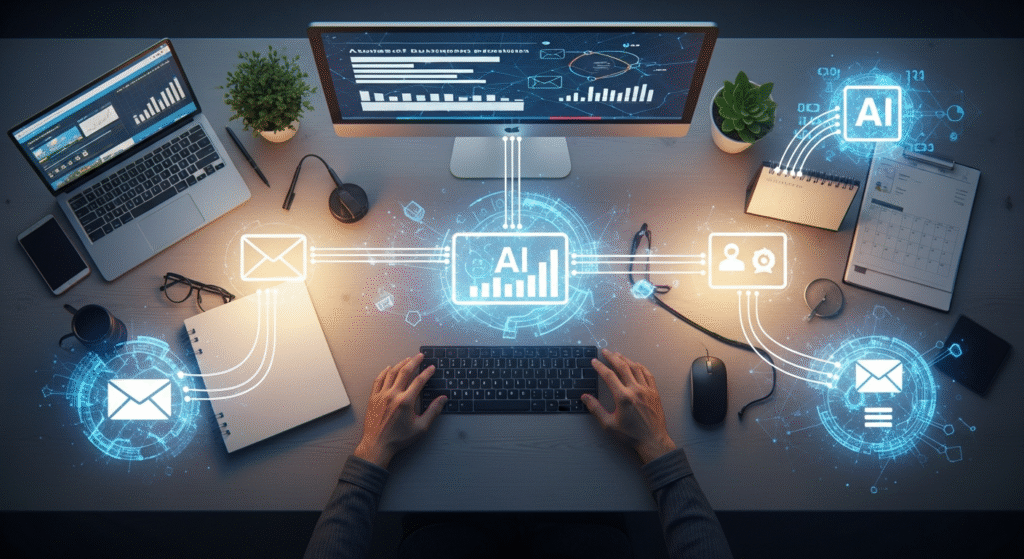
The use of AI agents has major advantages transforming the way business is done. Among the greatest benefits, there is the improvement of productivity as the systems do not need breaks or fatigue to work. They also lower operation cost since mass teams are less required to support repetitive operations. Enhanced accuracy is another significant advantage particularly in data based processes where errors by humans are prevalent. Scalability is also provided by the use of AI agents, where the businesses are able to grow without the cost-related growth. Moreover, they also offer insightful information based on the analysis of data, which assists companies in making more intelligent strategic choices.
Challenges and Limitations
In spite of the benefits, there are some challenges associated with AI agents that they cannot disregard. Job displacement is among the primary issues because automation can take the jobs that imply repetitive actions. Another important concern is data privacy because AI systems are highly dependent on huge amounts of sensitive data. There is also a question of the ethical considerations of making decisions that may affect people when it comes to AI agents and demands transparency and accountability. Moreover, companies can over-rely on technology and this may be dangerous when there are failures in the technology. These issues should be addressed to make the use of AI agents responsible and sustainable.
AI Agents in the Future 2026 and Beyond.
The future of AI agents is very bright with the improvement of technology. Such systems will be even smarter and they will be able to perform even more complicated tasks in a more efficient way. A major role will be played by human-AI collaboration where AI agents will perform routine work as human beings concentrate on creativity and innovations. The issue of emotional intelligence in AI will also be enhanced, and it will be easier to interact with users. Moreover, the use of robotics will make the AI agent do real physical work, which will broaden their scope of performance beyond the virtual world. Organisations that adopt this technology promptly will enjoy considerable competitiveness.
Conclusion
In 2026, AI agents are changing how business is carried out by eliminating the conventional work processes with smart, automated work processes. They are assisting businesses to be more efficient, cost saving and make better decisions. Although such issues as job displacement and data privacy are to be considered, the overall effect of the AI agents is very positive. The systems will be even more powerful and prevalent as the world of technology continues to evolve. Those organizations that embrace this change will be in a better place to succeed in the future of work.
FAQs
1. What is an AI agent?
An AI agent is the system, which is able to process data, make decisions, and take actions without the involvement of a human being all the time.
2. What is the workflow improvement of AI agents?
The workflows are made faster and more efficient by automating repetitive processes, streamlining processes, and offering real-time insights.
3. Are human positions being replaced by AI agents?
The agents of AI are substituting monotonous positions yet also introducing new ones that demand high levels of technical and creative expertise.
4. What are the most beneficial industries of AI agents?
Some of the best industries that AI agents have benefitted include healthcare, finance, e-commerce, and marketing.
5. What are the dangers of AI agent usage?
There are challenges of data privacy, ethical challenges, job loss, and technological dependence as their primary risks.